
Quick answer
The best stocking stuffers for toddlers are the small things the parent lists agree on: a board book, something to draw with and a sensory toy, each matched to the maker’s age label. For a child under 3, check every piece against CPSC’s small-parts rule before it goes in the stocking.
We earn from qualifying purchases made through links on this page. How this works
Top picks
- The Pigeon WON’T Count to 10! — a board book for babies and toddlers up to age 3.
- Hape Beaded Raindrops — a rainmaker for babies from birth.
- Munchkin Float & Play Bubbles — four floating bath toys for babies from 4 months.
- Melissa & Doug Water Wow Safari — a reusable water-reveal pad for ages 3 and up.
What should go in a toddler’s stocking?
Four things cover it: something to read, something to make marks with, something to handle, and one extra that matches whatever your child is into right now. Everything on this page fits a stocking and costs under $25 at the maker’s or publisher’s price.
The age label is the first thing to check, not the last. The AAP says the recommendation on a toy’s packaging gauges both safety and developmental fit, so a label that looks cautious is usually telling you something about what a child can do, not only about what is safe.
Buy fewer things. A board book, a box of chunky crayons and one sensory toy will still be in use in February; a bag of novelty trinkets will not.
Which small gifts do the toddler lists agree on?
Books appear on all seven of the toddler lists we read, but one list does not identify them as board books, so board books appear on six; crayons and a sensory toy appear on all seven, puzzles on three and bath toys on four. This table is the short version, grouped by type, with the maker’s age label, the maker’s or publisher’s price and the safety note that goes with each.
| Type | Example and maker age label | Price band | Small-parts or choking note | Lists including |
|---|---|---|---|---|
| Mini board books | The Pigeon WON’T Count to 10! (0–3) | Under $10 ($9.99) | Books and paper are exempt from the small-parts rule; check any attached toy or loose piece before wrapping. | 6/7 |
| Small puzzles | Melissa & Doug Jungle Friends Jumbo Knob Puzzle (1+) | Under $20 ($15.99) | The maker labels it 1+, so the under-3 small-parts rule applies; test each piece in the CPSC cylinder. | 3/7 |
| Crayons and art supplies | Honeysticks Originals 12-pack (1–3) | Under $25 ($24.95) | Crayons are exempt from the small-parts rule; the maker labels this set for ages 1–3. | 7/7 |
| Sensory and fine-motor toys | Hape Beaded Raindrops (0 months+) | Under $15 ($13.99) | The maker labels it from birth, so the under-3 rule applies; test it in the CPSC small-parts cylinder before wrapping. | 7/7 |
| Bath toys | Munchkin Float & Play Bubbles (4+ months) | Under $10 ($9.99) | The maker labels it 4+ months, so the under-3 rule applies; test it in the CPSC small-parts cylinder before wrapping. | 4/7 |
Prices are the maker’s or publisher’s own, as of November 2026.
One item from the board-book, crayon and sensory rows is the consensus list. The puzzle and bath rows are extras: worth adding if your child already loves puzzles, or if bath time needs a reset.
How do you check a stocking stuffer for small parts?
CPSC’s test is mechanical, and you can do it at the kitchen table. Under 16 CFR 1501, a toy intended for a child under 3 may not contain a small part, and a small part is anything that fits, without being compressed and in any orientation, into the small-parts cylinder described at 16 CFR 1501.4. A toy for under-3s that does contain one must carry a choking-hazard warning and an age label.

The cylinder is sized to approximate a young child’s throat, so the rule stands in for the question you are really asking: can this go in and not come out? The AAP’s version for parents is the “Think LARGE” rule — every toy and part should be larger than your child’s mouth.
Check the stuffer and everything that comes off it: caps, knobs, wheels, glued-on eyes, battery covers. Then check again after a week of play, because the piece that matters is the one that loosens.
Some items are exempt from the small-parts rule: books and paper, crayons, chalk, pencils, pens, modeling clay, fingerpaints and watercolors. Exempt is not the same as risk-free. It means the regulation does not cover that item, so the maker’s age label and your own check carry more of the weight.
What else should stay out of a toddler’s stocking?
Four things are worth ruling out before you shop: balloons, high-powered magnets, button batteries and small round objects.
- Balloons. CPSC says uninflated and broken balloons are a choking hazard and should be kept from children under 8.
- High-powered magnets. CPSC calls them a hazard from toddler through teen. Swallowed magnets can attract each other inside the body and may need surgery to remove, and some high-powered magnets are up to eight times stronger than ordinary toy magnets.
- Button and coin batteries. One can burn through a child’s throat or esophagus in as little as two hours. Toys that use them must have a compartment that needs a screwdriver, coin or other tool to open.
- Small round objects. The AAP says balloons, balls, marbles, toy pieces and other small round objects cause most choking deaths, and that choking is a leading cause of death for infants and children, with most deaths in children under 5.
ASTM F963 has been the mandatory US toy safety standard since June 2012. A toy with an age label, and a choking warning where one is needed, is the minimum to look for.
What are good stocking stuffers for a 2-year-old?
At 2, a child may point to things in a book, hold one object while using the other hand, try switches and knobs, and do simple shape puzzles, according to the CDC’s milestone list. That maps onto a board book, a knob puzzle and a toy with parts to turn or move.
A board book is the safest bet in the whole stocking: books are exempt from the small-parts rule, and pointing at pictures is exactly the play the milestone list describes.
Our pick
The Pigeon WON’T Count to 10!
A 24-page board book the publisher lists for ages 0–3.
- 24 pages, board-book format
- Publisher age label: 0–3
- $9.99 from the publisher as of November 2026
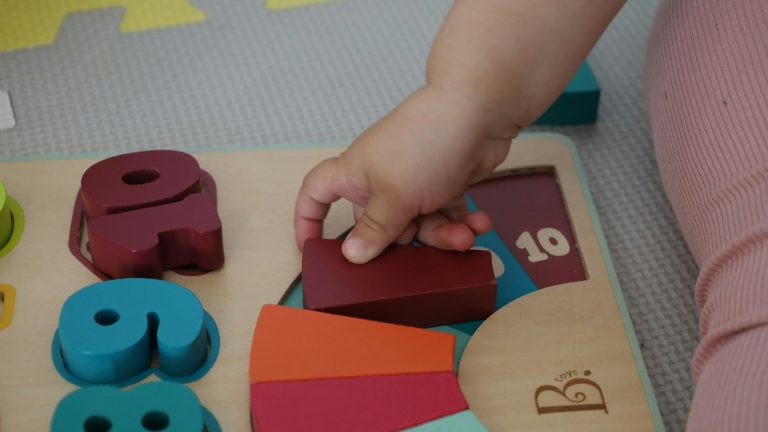
For puzzles, look for a knob puzzle, where each piece has a knob to grip. The Melissa & Doug Jungle Friends Jumbo Knob Puzzle has three pieces, a 1+ label and a maker’s price of $15.99 as of November 2026. Because it is labeled 1+, the under-3 rule applies, so each piece should be too big for the CPSC cylinder.
For the sensory pick, the simplest version for a 2-year-old is one that makes a sound when it moves.
Our pick
Hape Beaded Raindrops
A rainmaker the maker labels for babies from birth.
- Maker age label: 0 months+
- $13.99 from Hape as of November 2026
What are good stocking stuffers for a 3- or 4-year-old?
At 3, a child may string large beads or macaroni, draw a circle and use a fork; at 4, they may hold a crayon between fingers and thumb rather than in a fist, draw a person with three or more body parts, name colors and catch a large ball, the CDC says. Art supplies are the obvious fit.

Start with chunky crayons. Honeysticks labels its Originals 12-pack for ages 1–3 at $24.95 and its Jumbos 8-pack for ages 3+ at $16.95, both as of November 2026. Crayons are exempt from the small-parts rule, so the age label is doing the work of matching the crayon to the grip.
For a 3-year-old who wants something more contained, a water-reveal pad is the tidy option.
Our pick
Melissa & Doug Water Wow Safari
A reusable water-reveal pad the maker labels for ages 3 and up.
- Maker age label: 3+
- $8.99 from Melissa & Doug as of November 2026
- Reusable pad made for travel
A 4-year-old who is drawing people and naming colors fits the 3+ Jumbos rather than the 1–3 Originals, and a stack of plain paper will go further than another novelty.
Which bath toys are worth adding?
Bath toys appear on four of the seven lists, and the two that fit a stocking are both labeled for children under 3, so the same small-parts rule applies. Munchkin labels Float & Play Bubbles for 4+ months and lists the four-pack at $9.99; Boon labels PIPES for 12 months and up and lists the five-piece set at $16.99.
Our pick
Munchkin Float & Play Bubbles
Four floating bath toys the maker labels for babies from 4 months.
- Maker age label: 4+ months
- $9.99 from Munchkin as of November 2026
Both prices are as of November 2026. Before the first bath, test the toy in the CPSC small-parts cylinder, because a piece that comes off is what the under-3 rule is there to catch.
Do stocking stuffers for toddlers need to be educational?
No. The play does the work, and most of what the CDC lists at these ages is ordinary: pointing at a picture, turning a knob, scribbling, stringing large beads. A board book, a knob puzzle and a box of crayons cover more of that than a toy with “educational” on the box.
If you want one thing that lasts, a puzzle does: the CDC lists simple shape puzzles at 2, and drawing and naming colors at 3 and 4.
For bigger gifts to go under the tree, our guide to the best educational gifts for kids covers presents for the same ages.
FAQ
What are good stocking stuffers for a 1-year-old? A board book, a rainmaker labeled from birth and a bath toy labeled 4+ months are the safe starts. Anything labeled for under 3 has to pass CPSC’s small-parts rule, so check each piece, including caps and knobs.
Are crayons a choking hazard for a toddler? Crayons are exempt from CPSC’s small-parts rule, which is why chunky crayons are sold for ages 1 and up. The maker’s age label is still the thing to follow, and it is worth checking the box for broken pieces before you wrap it.
Do I have to follow the age label on a toy? Yes. The AAP says the recommendation on the package gauges both safety and developmental fit, so the label is about what a child can do as well as about what is safe.
Are puzzle pieces a choking hazard for a 2-year-old? Any piece that fits the CPSC small-parts cylinder is a small part and cannot be in a toy for under-3s. A puzzle labeled 1+ is intended for children under 3, so the small-parts rule applies; check each piece yourself.



Ask a question or share what worked